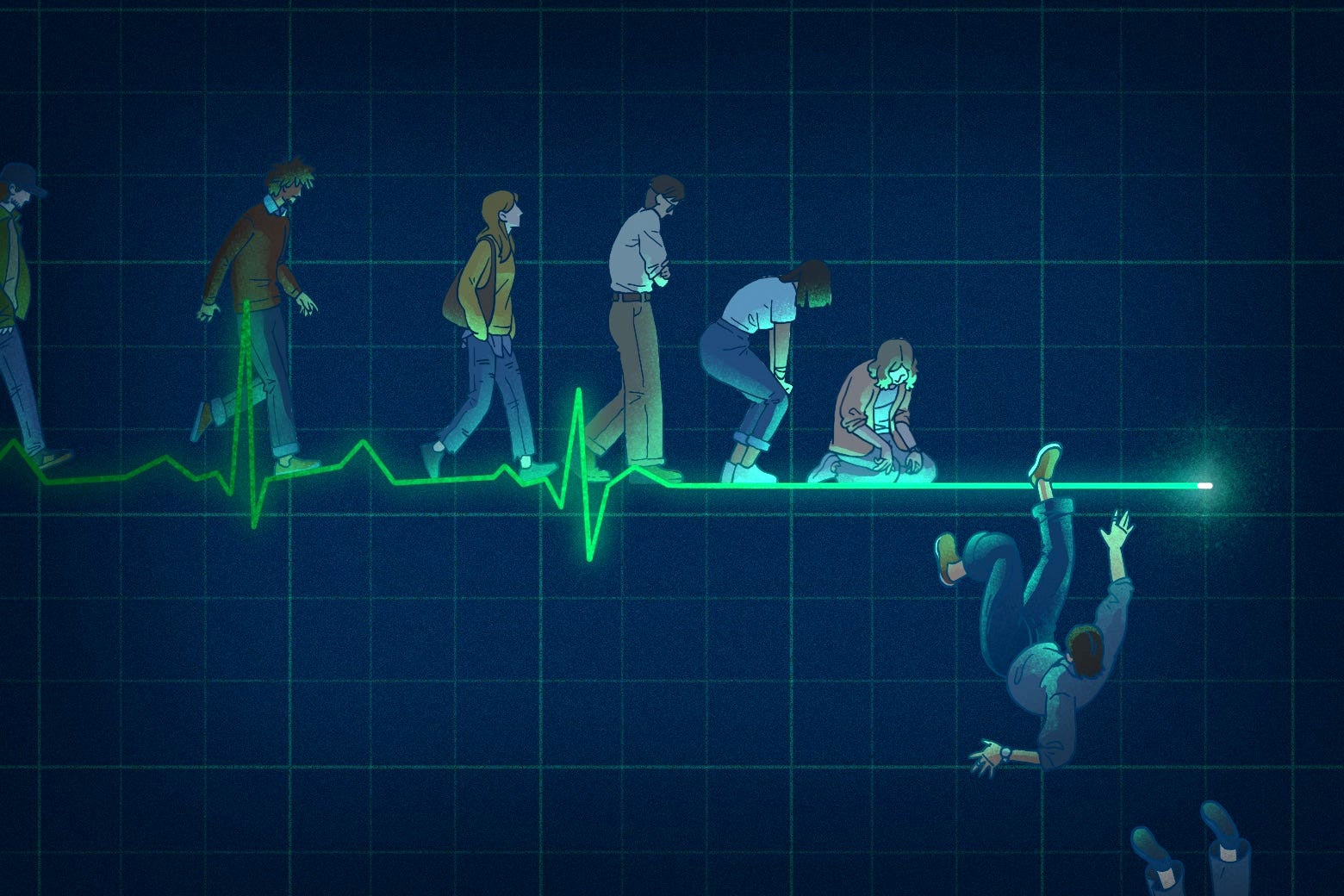
The article points to a cluster of causes rather than one culprit: shrinking economic opportunity, accumulated trauma, lack of affordable care across the life course (which leaves acute and chronic problems under-treated), and “deaths of despair” (suicide, alcohol, and drug overdoses). Car crashes and gun violence add to the toll, but this mix is what distinguishes younger U.S. cohorts from peers in other rich countries. The result is higher mortality for Millennials and now Gen Z, with little sign of improvement unless those conditions change.
For a while I have worried about how deeply market logic has seeped into every corner of modern life. We measure success in quarterly earnings and page views, not in wisdom gained or problems solved. The same pressure that turns art into disposable content has begun to turn science into a private club where access and recognition are rationed out by cost, prestige, and branding.
Capitalism’s influence is not new, but its present scale is unprecedented. Corporate funding steers research agendas toward fast-moving technologies that promise immediate returns. Universities fight for patents and spin-offs. Journals hide publicly funded findings behind paywalls that keep out anyone without an institutional badge. Even the informal conversations that once drove inquiry now live on platforms that monetize every click. Curiosity still exists, yet it is forced to pay rent in a marketplace of hype.
The article below captures this tension with unusual clarity. It challenges the idea that science is an open, self-correcting commons and argues that a small priesthood now controls who speaks, who is heard, and who gets the tools to test new ideas. I found it an important reminder that knowledge can be enclosed just as land can be fenced off.
If we care about the long-term health of science, we need to imagine structures that reward truth over profit and collaboration over gatekeeping.

If you care about digital ownership, consumer rights, and resisting corporate control over the things you "buy," check out Louis Rossmann's Consumer Action Taskforce. This wiki is dedicated to documenting the ways companies strip away our control over the products we purchase—whether it's Amazon revoking access to e-books, manufacturers locking down device repairs, or corporations pushing anti-consumer policies. Knowledge is power, and platforms like this help ensure we stay informed and fight back.
It’s disorienting to remember how hopeful I was back in the early days of when I was heavily involved in politics. I think that’s honestly one of reasons most people in the US are so disaffected by politics. We’ve all had our hopes crushed.
I really love all the hate Spotify is getting with this Joe Rogan controversy
They’ve been so toxic for the indie music scene and the music scene at large the last ten years. https://www.theguardian.com/music/2022/feb/02/smaller-artists-difficult-boycott-spotify-rogan-young-mitchell
Ex-Facebook engineer exposes H-1B visa abuse in Silicon Valley
Identity Politics and the Rise of the Republican Party
Identity politics are toxic. If Democrats don't start learning the lessons about this election that are right in front of their eyes they're going to lose again come midterms. Democrats just lost control of all three branches of government for the first time since 1928. It's time to reassess. Maybe take a look at what the populist leader on the left has to say..
Read moreFor all my conservative friends, this perfectly illustrates the hypocrisy of conservative politics. It's always fiscally irresponsible until it affects them directly. Conservatives tell me that tuition free college isn't "realistic", that raising taxes on the 1% would destroy the economy, that reenacting the Glass-Steagall Act to prevent risky banking practices that lead to the 2008 finical collapse is 'over-regulation' and unreasonable.
Have you ever seen the movie The Big Short that came out last year? It's about the 2008 financial crisis and how the deregulation of Wall Street caused the greatest financial disaster since The Great Depression. Before the credits roll at the end of the movie they say that no one learned from 2008, and that the same risks are being taken again.
The banks didn't want the federal government to get involved until they needed to be bailed out. Conservatives are believers in the so called 'free market' until they're not. People argue conservatism as if it's philosophically valid but in the real world they're just protecting their own interests. What do they have to gain by making college free? They graduated 20 years ago or they own a business or were, like Donald Trump, born on third base and go through life thinking they hit a triple. Where all the conservatives who make $12 and hour. You won't find any.
The federal government should act in the best interests of the American people, not just the people rich enough to influence our political system. In philosophy there is an ethical concept introduced by Immanuel Kant called the Categorical imperative. It's basically a way of evaluating whether or not an action is ethical. The Categorical imperative says that whenever we consider completing an act, we should also consider what kind of things may occur if what we choose to do were applied across the board to everybody.
A guy walks up to a woman at a bar. He flirts with her. He makes small talk, but the woman insists she isn't gonna go home with him.
Guy says, "What if I offer you $1 million to sleep with me?" The woman's never had a million dollars in her life. She stops and considers the offer very seriously.
The guy changes his mind, says, "What if I change my offer to a dollar instead?"
Woman is aghast. "What kind of woman do you think I am?"
Guy says, "We already figured that out. Now we're just negotiating."
This is exactly how I feel when I honestly try to imagine myself voting for Clinton. For weeks all we heard about was the 'Platform' and how Bernie was helping to make it the most progressive in history. But ultimately the platform doesn't mean anything. Bernie's endorsement doesn't make me want to vote for Hillary because when I voted for Bernie in the primary it wasn't just because I believe in him. A large part of why I voted for Bernie is because I believe establishment politics are broken and the system is so far removed from being a functioning democracy. I voted for him because I reject the judgment, Neoliberal philosophies, and the lack of character of Hillary Clinton. Those reasons didn't suddenly disappear. Neither Trump or Hillary are fit to be president and I intend to fight on for the revolution by supporting downticket races and promoting the hell out of Jill Stein.
I'll be the first to admit that since the endorsement it's been tough getting out of bed in the morning. But I wrote a few lines of Homer to hang on my door for inspiration when I go out every morning:
Striking his breast, reproved his heart with the worlds:
'Endure, my heart; e'en worse thou didst one endure.'
The Bern for Revolution In My Heart
The Democratic National Convention is a month away and I've never felt such compulsion in my life. I can feel the winds of revolution rising to the chorus of millions of Americans suddenly realizing impossible is nothing, defeat is never permanent and to struggle for justice is to earn this precious gift of life we've all been given.
With my calendar laid out in front of me and a stack of unpaid bills to my left I'm trying to imagine a way. I'm trying to imagine how I might get there, how it might work out, and then I'm also trying to imagine setting aside the dream to honor my responsibilities. Imagining the latter tears me apart inside. I won't pretend i'm right all the time but I do try to stay as close to the edge as I can. By that I mean that out on the edge you see all kinds of things you can't see from the center. Most people stick to the center, society couldn't function if it didn't teach people to need the safety and predictability of that place where you obey authority, pay your bills, have kids and raise them to become another self-multiplying cog in the machine.
But the edge, that's where you get dirty and accept pain and rejection in return for something quite different. True courage is only found after learning what there is to be afraid of by experiencing it. You can never understand the shape of the world until you've spent some time near the edge, out where you might fall over. I walk beside the edge as much as I can trying to catch a glimpse, straining to hear a whisper of what is, what's to come, and what might be. If I had been alive during the mid 18th century I'd like to imagine I'd have written an almanac entitled 'depending on the whether'. But almanacs have become relics from our time spent toiling in agrarian society and like the the fruits of the American revolution, are outdated beyond usefulness. The orbit of the earth and the position of the stars in our sky can offer no guidance in a world that frequently changes overnight. In order to see the shape of things, I stay as close to the edge as I can without going over.
Here I am now, at the precipice with the wind howling at my back. Everything i've learned, all the doubt, the fear, the pain and the hope- it all tells me now is the time to take a step without feet. The winds have never spoken more of revolution, perhaps won't again for another 20 years. I'd hate to miss it. Depending on the weather.